
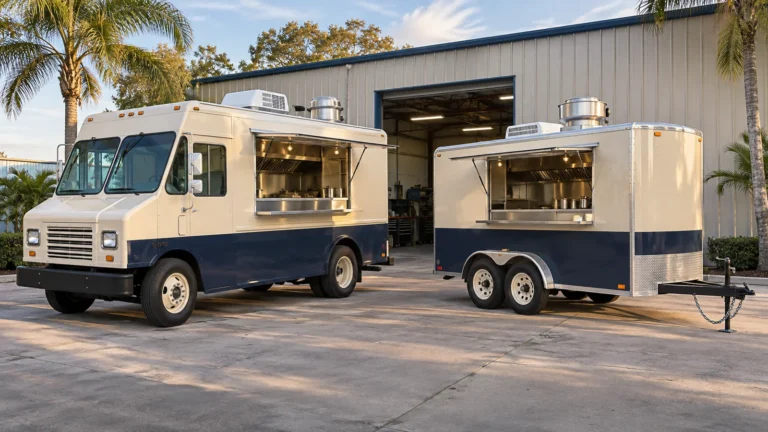
Use your menu, routes, and service routine to decide whether a food truck or food trailer makes more sense for your business.
A food truck carries its kitchen and drivetrain in one vehicle. A food trailer carries the kitchen in a separate unit that you move with a tow vehicle. That difference changes how you get to a site, what you maintain, and how you set up for service. Before choosing either, picture what a normal operating week will look like.
Start With Where and How Often You’ll Move
A truck may make sense if you plan to move frequently between service locations and want one vehicle for transport and cooking. Think through the actual route, parking, site access, and where you will store the truck between shifts.
A trailer may make sense if you already have a suitable tow vehicle or expect to stay at a site for longer stretches. Consider how much room you need to maneuver and park both vehicles, as well as where you can store the trailer when it is not in use. Confirm the tow setup with the relevant providers before choosing the trailer.

Design the Kitchen Around the Menu
Write down what you will cook, how you will prep it, what needs refrigeration, and how orders will move from the cooking line to the service window. Then count how many people need to work inside during a busy shift.
A compact menu can fit a compact workflow, but equipment, storage, and staffing still need space. Ask to review a proposed layout before selecting a unit based on its exterior size. The better layout is the one your team can work in during a busy service.
Compare the Two Formats Side by Side
| Decision | Food truck | Food trailer |
| Moving between sites | Drive the kitchen as one vehicle. | Move the kitchen with a separate tow vehicle. |
| Site access and storage | Account for the kitchen and vehicle in one unit; a mechanical issue can affect mobility. | Account for both the trailer and tow vehicle; confirm how you would move the unit if the tow vehicle is unavailable. |
| Maintenance | Account for the kitchen and vehicle in one unit; a mechanical issue can affect mobility. | Account for both the trailer and tow vehicle; confirm how you would move the unit if the tow vehicle is unavailable. |
| Layout | Review usable space around the vehicle structure. | Review usable space based on the trailer dimensions and proposed layout. |
| Budget | Compare the vehicle, build scope, and expected operating costs. | Compare the build scope, towing setup, and expected operating costs. |
Neither format has a universal price or space advantage. Compare written proposals with similar equipment and build scope, then include the costs your own operating plan will require.
Picture Your First Week of Service
Suppose you plan to serve lunch at different office sites during the week. A truck might be worth evaluating because moving often is part of the plan. If you expect to serve most days from a location with adequate trailer access and you already have a suitable tow vehicle, a trailer might be a better starting point.
These are hypothetical examples. Verify site rules, setup needs, and access at each location before deciding.
What to Bring to a Quote Conversation
Share your menu, equipment list, crew size, service locations, and how often you expect to move. Include any vehicle you already own, storage and access limits, your budget range, and your target opening date. Ask for a proposed layout, included equipment, exclusions, and the details that need further review.
Explore JR Customs’ custom food trucks and custom food trailers. If you are still deciding between them, tell the team how you plan to operate so you can discuss both formats against the same needs.